Jubilee Lake Pilot Project
The Jubilee Lake Pilot Project began with one simple belief: public lands should be available to everyone, including people who experience life from a wheelchair, power chair, walker, stroller, or any other position that makes a deteriorating trail more than an inconvenience.
Led by the Brent Oliver 541 Foundation in collaboration with the United States Forest Service, elected officials, accessibility advocates, engineers, contractors, volunteers, industry professionals, nonprofit organizations, and community partners, the project focuses on repairing and maintaining an existing one-mile hard-surface foot trail at Jubilee Lake in the Umatilla National Forest.
This is not a proposal to build a new trail. It is not an expansion into undisturbed land. It is not an attempt to change the character of Jubilee Lake. The work is intended to remain inside the established, previously disturbed trail corridor and preserve a recreation asset that was built for meaningful access but has deteriorated through more than three decades of use and deferred maintenance.
The goal is straightforward: repair what already exists, learn from the work, document the results, and develop a practical maintenance model that can be repeated elsewhere.
Why Jubilee Lake Matters
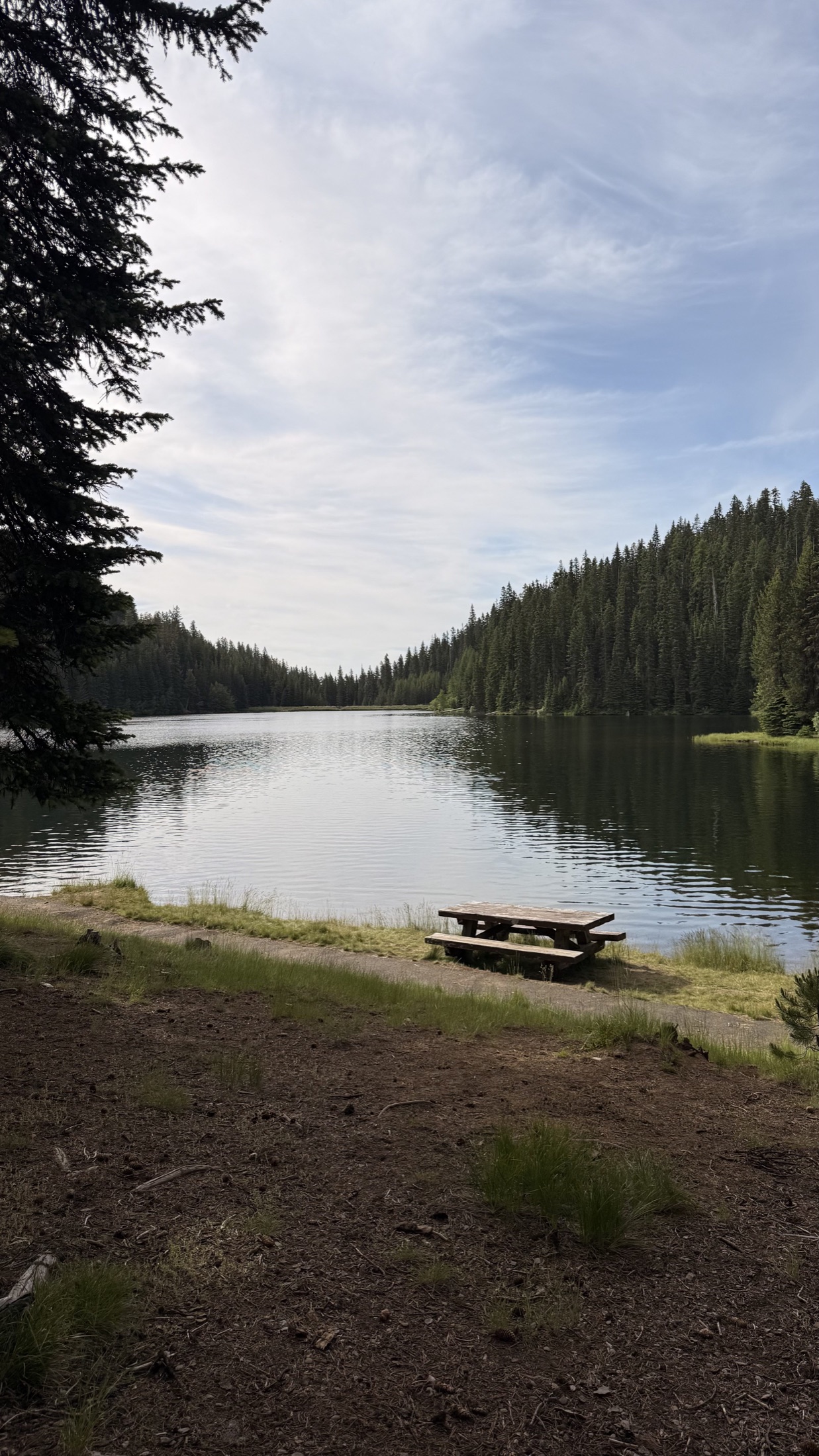
The hard-surface trail at Jubilee Lake was built in 1992 to provide people with mobility limitations a meaningful opportunity to experience the outdoors. It does not circle the entire lake, and it is not a bicycle trail. It is an existing hard-surface foot trail serving one of the most heavily used recreation sites in the region.
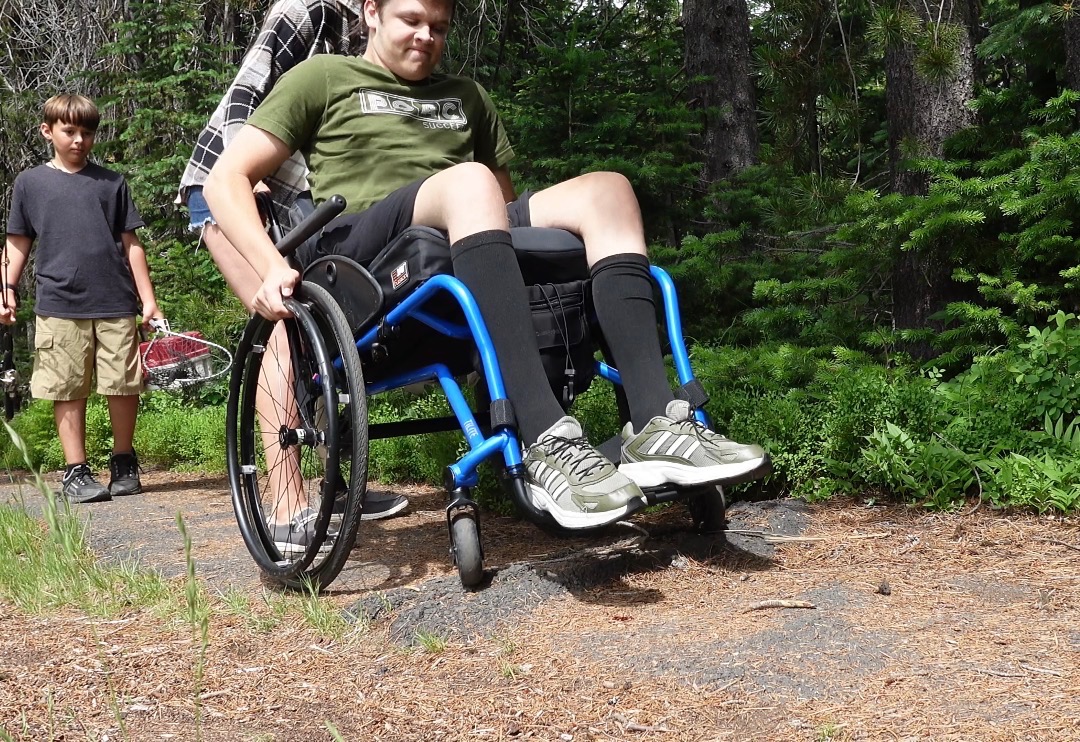
For many visitors, walking the trail may seem simple. For someone using a wheelchair or power chair, however, a root heave can become a wall. A deep crack can catch a wheel. A sudden change in elevation can cause a mobility device to tip. A fallen tree can completely end the trip.
The trail has experienced severe pavement deterioration, root displacement, uneven surfaces, cracks, and other barriers that make portions difficult or impossible to navigate safely. During the shoulder seasons, the main entrance gate may also be closed even when conditions would otherwise allow people to enjoy the area.
The difference between theoretical access and meaningful access is what happens when a person arrives. Can they actually use the trail? Can they reach the lake? Can they safely move through the recreation site with their family? Or does their experience end at the first preventable barrier? That is why Jubilee Lake matters.
Who the Project Serves
The project is often described through the experience of people with disabilities, but meaningful access serves a much larger part of the public.
It serves the veteran who wants to fish with his grandchildren. It serves the older person who needs a walker to reach a favorite place beside the water. It serves the child who uses a wheelchair and deserves the same opportunity to experience nature as every other child.
It serves the parent pushing a stroller, the grandparent pulling a wagon, the person recovering from surgery, and the family member whose mobility changed because of an injury or illness. It also serves every person who may be able-bodied today but will experience life differently tomorrow.
Age, injury, disability, illness, and changing mobility eventually touch nearly every family. Meaningful access is not a special privilege for a small group of people. It is the preservation of an opportunity that any of us may need. One day, you may be the person looking at the trail from a seated position. One day, it may be your spouse, your child, your parent, your grandparent, or your closest friend.
A Multi-Year, Multi-Phase Project
The Jubilee Lake Pilot Project is a multi-year, multi-phase effort beginning in the fall of 2026.
Phase One will focus on light brush clearing, removal of obstructions, hazard documentation, limited trail preparation, and small repair and resurfacing test paves within the existing, previously disturbed trail corridor. These test sections will allow the project team to evaluate maintenance materials, mix designs, placement methods, durability, cost, and long-term performance under actual mountain conditions.
The test sections will be observed through winter weather, freeze-thaw cycles, runoff, root movement, public use, and ordinary maintenance demands. The information gathered will be documented and used to guide the next phase of the project.
Phase Two will use the agreed-upon mix designs, maintenance methods, and lessons developed through Phase One to prepare and implement trail maintenance on larger portions of the existing trail. Later phases will continue applying what is learned as resources, authorization, and partnerships allow.
The work is not intended to relocate the trail, widen it into a new corridor, or develop previously undisturbed land. Everything learned will be documented so other forests, parks, agencies, nonprofit organizations, engineers, contractors, and communities can benefit. The project is designed to be practical, measurable, and repeatable. Jubilee Lake is not the destination. It is the proving ground.
Why This Became More Than One Trail
The Brent Oliver 541 Foundation did not begin this project with the intention of challenging public policy or questioning federal spending. We began because an existing trail designed to provide meaningful access had deteriorated to the point that people with mobility limitations could not safely use it.
As we worked to understand how the trail reached that condition, a larger question emerged: How did the National Forest System accumulate a deferred maintenance backlog of approximately $10.8 billion, and why does that backlog continue to grow by nearly $1 billion each year despite substantial annual appropriations?
That question led us into a broader examination of stewardship, maintenance priorities, engineering practices, public spending, accessibility obligations, project selection, and whether taxpayer investments are producing measurable improvements on the ground.
Our purpose is not to declare that every decision is wrong. Managing public land is complicated. But when the deferred maintenance backlog continues to grow while public infrastructure deteriorates, taxpayers are entitled to ask how priorities are being established and whether spending is producing lasting results.
We are asking whether expenditures produce measurable stewardship, whether taxpayers are receiving lasting value, and whether modern maintenance practices, better planning, stronger partnerships, and measurable accountability could produce better results.
Stewardship and Opportunity Cost
The Forest Service has announced approximately $80 million for 15 Legacy Landscape projects covering roughly 34,000 acres of privately owned forestland. Those projects may serve important conservation or land-management objectives. The Foundation is not declaring them right or wrong without fully understanding their purpose, implementation, and measurable results.
But the spending raises a legitimate question. When tens of millions of taxpayer dollars are being invested in privately owned land while existing public infrastructure continues to deteriorate and the deferred maintenance backlog grows by nearly $1 billion each year, how are those priorities being evaluated?
This is not an argument that one program must automatically be eliminated to fund another. It is an argument for transparency, measurable accountability, and responsible stewardship of assets the public has already paid to build.
The Foundation believes deferred maintenance is not only a funding problem. It is also a stewardship problem. Better planning, preventative maintenance, modern repair methods, measurable outcomes, and stronger public-private partnerships can extend the life of existing infrastructure, reduce future liabilities, improve public safety, and make limited taxpayer resources go further. Jubilee Lake gives us an opportunity to test that belief through action.
Meaningful Access and Federal Law
Section 504 of the Rehabilitation Act of 1973 prohibits discrimination on the basis of disability in programs and activities conducted by federal agencies. The Architectural Barriers Act of 1968 establishes accessibility requirements for certain facilities designed, built, altered, or leased with federal funds. These are laws passed by Congress. They are not optional agency preferences.
The Forest Service Outdoor Recreation Accessibility Guidelines and the Forest Service Trail Accessibility Guidelines provide technical direction for designing, maintaining, and evaluating recreation opportunities where accessibility can reasonably be achieved while respecting natural-resource conditions.
Meaningful access does not require every trail or every acre of public land to be accessible. It does require serious consideration of whether avoidable barriers are unnecessarily excluding people with disabilities from facilities and recreation opportunities that are otherwise available to the public.
The Jubilee Lake project has raised a direct question: If Congress has established legal obligations, under what circumstances can internal policies, staffing limitations, qualification requirements, equipment restrictions, or administrative procedures produce an outcome that appears inconsistent with those obligations? Stated plainly, when do internal rules outweigh legal duties established by Congress?
The Fallen-Tree Example
One experience at Jubilee Lake brought those questions into sharp focus. A large fallen tree completely blocked the existing hard-surface trail. The trunk stretched across the only practical route available to wheelchair users, power-chair users, many older visitors, and families using strollers or wagons.
A hand crew later worked at the location. The limbs were removed from the tree, the brush was piled beside the trail, and similar work was performed on dozens of other fallen trees. But the trunks, root masses, and substantial obstructions were left in the trail. The crew reportedly did not include a person qualified to operate a chainsaw, so the work stopped before the barriers were removed.
If a federal agency knows that a barrier remains on a recreation facility designed to provide meaningful access, sends personnel to that location, performs partial work, and leaves the facility unusable because internal rules prevent completion, how does the agency determine that it has fulfilled its obligations? Does partial maintenance satisfy a legal obligation when people with mobility disabilities still cannot use the facility?
We are not claiming to have the final legal answer. We are asking the question because it deserves a clear answer. Internal procedures should help agencies fulfill federal law, not leave known barriers in place while the legal obligation remains unanswered.
Collaboration Instead of Conflict
The Foundation's objective is not to create conflict. Our objective is to create solutions.
The Jubilee Lake Pilot Project is a true collaboration between the United States Forest Service, the Brent Oliver 541 Foundation, private-sector businesses, volunteers, engineers, contractors, suppliers, accessibility advocates, community organizations, and other 501(c)(3) nonprofit organizations.
Together, these partners are creating a public-private-nonprofit model that can stretch limited resources, improve accountability, and produce measurable results.
The project has received letters of support and collaboration from Oregon State Senator Todd Nash, Oregon State Representative Greg Smith, Oregon State Representative Bobby Levy, Union County, Umatilla County, and the United States Forest Service. Local Forest Service leadership within the Walla Walla Ranger District has authorized and collaborated with the project.
The project has also helped support the development of the Meaningful Access Coalition, bringing together individuals and organizations that believe accessibility, conservation, stewardship, fiscal responsibility, and measurable outcomes can work together. Accessibility and conservation are not competing responsibilities. They are part of responsible public-land management.
A Pilot Project With National Potential
Jubilee Lake is one trail in northeastern Oregon, but the questions surrounding it are national. How do we protect infrastructure taxpayers have already paid to build? How do we keep small maintenance problems from becoming expensive reconstruction projects? How do we measure whether public spending is improving conditions on the ground?
How do we use private-sector expertise, local partnerships, volunteer support, nonprofit organizations, and modern repair practices to make public resources go further? How do federal agencies reconcile internal policies with civil-rights obligations established by Congress? How do we ensure that people with disabilities are not left behind?
Success will not be judged only by what happens at Jubilee Lake. It will also be judged by whether the lessons can be documented, shared, and applied to other public recreation facilities.
If we succeed, one trail will be repaired. If we succeed together, we will create a repeatable stewardship model capable of improving public lands throughout the United States.
Protect what already exists. Maintain it before it fails. Measure the results. Learn from the data. Share what is learned. Keep improving.
Taking the Conversation to Washington, D.C.
In September, representatives of the Brent Oliver 541 Foundation will travel to Washington, D.C., with the BlueRibbon Coalition to meet with members of Congress and federal policymakers.
Those discussions will include the Outdoor Americans with Disabilities Act, meaningful access, stewardship accountability, deferred maintenance, fiscal responsibility, public-private partnerships, and what responsible stewardship should look like on America's public lands.
Jubilee Lake will provide a real-world example of both the challenges and the solutions. We intend to ask how Congress expected federal accessibility laws to be implemented, how agencies interpret their responsibilities, and what accountability exists when known barriers remain.
We will also take a multi-year, multi-phase pilot project, a working collaboration, letters of support, and a practical model designed to produce measurable results on the ground. This conversation is not only about what has gone wrong. It is about what can be done better. That is the story Jubilee Lake can take to Washington.
Why Your Support Matters
This project will not succeed through words alone. It will succeed because people decide it matters enough to act.
Every volunteer hour matters. Every donated material matters. Every piece of equipment matters. Every professional contribution matters. Every letter of support matters. Every donation matters.
Your support helps fund and carry out the fall 2026 work, evaluate repair materials and methods, move the project into Phase Two, and coordinate the partners and community members contributing to this work.
You are not simply helping repair one trail. You are helping prove that meaningful access and responsible stewardship can work together. You are helping veterans, older people, children who use wheelchairs, parents pushing strollers, grandparents pulling wagons, and families whose lives have been changed by injury, illness, age, or disability.
Before leaving this page, picture the trail from a seated position. Imagine reaching a place that was built to provide meaningful access, only to find broken pavement, severe root heaves, a closed gate, or a fallen tree blocking the only route available to you. Imagine watching others step over the obstacle and continue while your day ends at the barrier.
Stewardship is not measured by promises. It is measured by what people experience when they arrive. Meaningful access is not achieved through words alone. It is achieved through action.